
Alina Kabaeva was first linked to Putin more than a decade ago, while she was a medal-winning gymnast.

US Deputy National Security Adviser Daleep Singh also referred to the 'no limits' partnership between Moscow and Beijing and said no one believes that Russia would come running to India's defence if China breaches the Line of Actual Control.
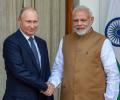
By driving a hard bargain with Russia in procuring crude oil at the lowest price possible, India is furthering the policy of G7 and Washington is "comfortable" with New Delhi over its approach in addressing issues relating to energy security, a top Biden administration official said.

The tweets by Shehla, dated August 18, 2019, had accused the Army of entering houses and "torturing" locals in Kashmir.

India will soon meet Iraq and the United Arab Emirates (UAE) to seek a definitive rate of discount on crude oil similar to what Russia has provided so far, sources said. Multiple officials and industry executives said Iraq, which is India's biggest oil supplier, wants to discuss the level of discounts expected by Indian refiners. India's focus on snapping up ever-increasing volumes of Russian crude oil has led to a corresponding decline in imports from the Middle East. Flows from Iraq, Saudi Arabia, and the UAE have suffered as a result.

Virtually putting India and 11 others countries on notice, the United States has asked them to significantly reduce by June 28 the purchase of Iranian oil to avoid sanctions, as it announced a list of nations that will be exempted from the curbs.

State Bank of India, the nation's largest lender, has stopped processing transactions of Russian entities that have been sanctioned by the West over Moscow's invasion of Ukraine, sources said. To effect this, SBI has issued a circular as it fears that any transaction with entities or sectors under sanction will invite sanction on it as well, sources said. No transactions involving entities, banks, ports or vessels appearing on a US, European Union or United Nations sanctions list would be processed irrespective of the currency of the transaction, they said. Payments due to such entities have to be processed by other mechanism rather than through the banking channel, sources added.

Russian oil supplies to India will continue to flow unhindered and suppliers will come up with ways to sidestep secondary sanctions, a Russian official told Business Standard.

Taking advantage of a Russian offer to sell its crude oil cheap and bear the cost of insurance and transportation, India may import as much as 2 million tonnes (mt), or roughly 15 million barrels of crude, from the sanctioned nation in 2022, Business Standard has learnt. This comes after reports that Indian Oil Corporation (IOC) bought 3 million barrels of Russian Urals from trader Vitol for May delivery. This will be on cost, insurance and freight (CIF) model, where the seller incurs the costs and pays the freight, including insurance charges.

'The Ruble is now down 50 per cent and worth less than one American penny since Putin announced his war'
India on Wednesday asserted that its energy purchases from Russia remain 'minuscule' in comparison to its total consumption and that legitimate energy transactions cannot be politicised as energy export from Russia are yet to be sanctioned. The world's third-biggest oil-consuming and importing nation has in recent weeks snapped few cargoes available from Russia at deep discounts as part of its plans to diversify its import basket. These purchases have been commented upon.

Putin is keen on establishing a good personal rapport with Trump and anchor a meaningful US-Russia partnership, realistic enough to accept that Trump is as good an American president as Russia would ever get, observes Ambassador M K Bhadrakumar.

"We do not think India should accelerate or increase imports of Russian energy and other commodities even as, obviously, those decisions are made by individual countries," White House Press Secretary Jen Psaki told reporters at her daily news conference.
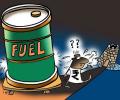
As stringent sanctions imposed by the European Union and US are crippling business and trade, desperate Russian oil companies are offering huge discounts to India, provided a payment mechanism to bypass the SWIFT ban is quickly approved by the government. According to sources familiar with the development, Russian oil firms are offering 25-27 per cent discount to the dated Brent crude prices. State-run Rosneft is one the biggest oil companies that supply crude to India.

Brand IPL has become stronger than ever and doesn't see any threat from the growing number of T20 leagues globally, its chairman Arun Dhumal said on Saturday as he steered clear of the speculation swirling around a tournament backed by Saudi Arabia.

Higher discounts on crude oil offered by the United Arab Emirates (UAE) to wean India away from Russian crude may soon see Indian refiners ramping up purchases from the Gulf nation, officials at multiple refiners said. They also pointed to the recent agreement on trade settlement in national currencies signed between India and the UAE as a reason for this. "While discussions are underway, the UAE has offered discounts on crude, which will be more than that of the current level of Russian discounts.

Russia has already begun delivery of the first S-400 systems, and the question of sanctions, or of a waiver to sanctions, preoccupies New Delhi.

Tehran plans to lift exports by 500,000 barrels per day

The escalation of conflict in the West Asian region is expected to push already high logistics costs besides hurting trade in sectors such as oil, electronics and agriculture, according to exporters. They said that insurance costs for exports to the countries directly involved in the war could also go up, which will impact Indian exporters' working capital. Think tank Global Trade Research Initiative (GTRI) stated that the conflict is already hurting India's trade with countries like Israel, Jordan, and Lebanon.

On the back of rising crude oil purchases, India's bill for imports from sanctions-hit Russia jumped 3.5 times in a year in April to $2.3 billion, showed data from the commerce ministry. In April, India's crude oil imports from Russia were valued at $1.3 billion, 57 per cent of India's total inbound shipments from Russia. Other major imported items during the month included coal, soybean and sunflower oil, fertilisers, and non-industrial diamonds. That month, Russia was also the fourth-largest crude petroleum supplier to India, after Iraq, Saudi Arabia, and the United Arab Emirates (UAE).

India, the world's third largest oil consuming and importing nation, in July bought $2.8 billion worth of crude oil from Russia, second only to China which remains the largest importer of Russian oil, a report said. Russia emerged as India's biggest supplier of crude oil, which is converted into fuels like petrol and diesel in refineries, after Russian oil was available on discount following some European nations shunning purchases from Moscow over its invasion of Ukraine in February 2022.
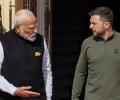
Prime Minister Narendra Modi on Friday invited President Volodymyr Zelenskyy to visit India and the Ukrainian leader said he would be happy to travel to the 'great' country.

Delicious snacks, parathas made from sabudana.

Despite discounts on Russian crude oil - which fell to the lowest since the Ukraine war began - and the rising sanctions, import volumes from the country will remain stable for now or at least till July, said refinery officials. "There is an appetite for Russian crude, and shipments are not expected to taper off beyond this point unless something major happens. "Talks are on, and buying will continue," an official at a major refinery said.

Investors are showing some interest in the downstream energy cycle. Refiners and marketers, especially the public sector (PSU) oil marketing companies (OMCs) could see a revival of marketing margins. Lower crude oil and gas prices may also improve margins in industries like paints, logistics, synthetic fabrics, plastics, and fertilisers. In the medium-term, however, there could be a supply overhang affecting OMCs as new refining capacities are scheduled to be commissioned, especially in China, and this may lead to a drop in the refining margins as capacity would be surplus to demand until and unless there's a pick-up in global growth.

India is deeply concerned over the spike in the price of oil due to the Russia-Ukraine conflict and it is "breaking our back," External Affairs Minister S Jaishankar has said. Addressing a joint press conference with US Secretary of State Antony Blinken after holding bilateral talks, Jaishankar on Tuesday said there is a very deep concern among developing countries about how their energy needs are addressed. Speaking about the Ukraine war, he said: "We have taken the position privately, publicly, confidentially and consistently that this conflict is not in anybody's interest."
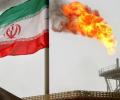
Iran has offered to help India meet its energy needs by relaunching rupee-rial trade for export of oil and gas, said Iranian ambassador to India Ali Chegeni. Chegeni said if both the countries resume rupee-rial trade, bilateral trade can touch $30 billion. Iran used to be India's second largest oil supplier but New Delhi had to halt imports after the former US president Donald Trump withdrew from the nuclear deal with Iran and re-imposed sanctions on its oil exports.
A few years ago, when top officials of Indian state-run refiners went to Dubai to negotiate a crude oil supply contract, a senior official from state-owned Saudi Aramco told them, "We can negotiate on anything, but I am the last man standing for you. "Nobody can offer the range of crudes we do with certainty," an official who was part of the negotiating team recalls. Perhaps that explains why Saudi Arabia is less concerned about losing its place as India's premier oil supplier to an upstart like Russia, which emerged from nowhere to become India's biggest crude oil supplier in September and October.

'The touchstone is reciprocity which will be applied to friends and foes alike.' 'It will be a bitter pill to swallow.'

Russia has been grappling with sanctions slapped by the US and its allies over Moscow's invasion of Crimea.
Come December, India may have to re-evaluate purchases of Russian oil if a price cap on crude oil proposed by the US and the European Union (EU) comes into effect. That impacts nearly a quarter of India's oil purchases that come at a discount, helping limit marketing losses for India's state refiners and enabling New Delhi to manage inflation by freezing pump prices of motor fuels. In September, India imported 1 million barrels a day or 24 per cent of its overall imports from Russia, which became the biggest supplier of oil to India.

The President said he made the decision in consultation with European allies but added they may not be in a position to join the US in banning Russian energy imports.

'Russia has got inherent military strength, they have a very good military equipment manufacturing infrastructure and by and large they are self-sufficient in their production capabilities'

International oil prices retreated from an over seven-year high but was still above $100 a barrel and continue to pose threat to India's inflation rate and current account deficit. While there are no supply concerns as the oil route remained open, consumers will feel the pinch when PSU oil firms start passing on the increase in international rates through a revision in petrol and diesel prices, which have been on a pause for over three-and-a-half-months in view of elections in Uttar Pradesh and four other states. The government is "closely monitoring the situation" and will "take appropriate steps as and when required", a top official said. Brent crude oil surged past $105 per barrel on Thursday for the first time since August 2014, following Russia's invasion of Ukraine.

'He needs to see results while he is in office.'

After a robust 2023, foreign investors significantly scaled back their investments in Indian equities in 2024, with net inflows amounting to over Rs 5,000 crore, as elevated domestic valuations, coupled with geopolitical uncertainties prompted investors to adopt a more cautious stance. Looking ahead to 2025, FPI flows into Indian equities could see a recovery, supported by a cyclical upswing in corporate earnings, particularly in domestic-oriented sectors like capital goods, manufacturing, and infrastructure, Vinit Bolinjkar, head of research, Ventura Securities, said.

Carter was in politics, but not a politician, certainly not a transactional politician, points out Shreekant Sambrani.

President Trump, in a move that could have implications on India's energy security, on Monday decided not to grant sanctions exemptions to any oil customers of Iran, further squeezing Tehran's top export commodity.

Lisa Curtis, who served as deputy assistant to President Trump and as National Security Council senior director for South and Central Asia from 2017 to 2021, said she expected the same bumps for India and the US, as in Trump's first term, including tariff, dependence on Russia over arms supply and oil purchase from Iran. Curtis, however, said both countries could never enter an alliance but develop a partnership that is "short of an alliance". She hoped them to achieve a cooperation that deters China, but also prepares both countries in case of a crisis or conflict, be it in the Taiwan Strait, the South China Sea, or another flare-up on the India-China border.

From the Sensex basket, Larsen & Toubro, Maruti, Reliance Industries, Nestle, Bharti Airtel, UltraTech Cement, Kotak Mahindra Bank and JSW Steel were among the major laggards. Bajaj Finance climbed nearly 1 per cent higher.
